I-Support
3D pneumatically actuated soft robot based on the I-Support platform.
Overview
ISupport is a specialized PCS implementation for 3D pneumatic soft robots.
Its pressure chambers use the common threadlike-actuation model: each physical
chamber is represented by a straight, segment-local equivalent path through the
deformable pneumatic section.
- 3 chambers per segment: Radially arranged pneumatic chambers
- Pressure-based control: Direct pressure input for actuation
- I-Support platform: Specific configuration for the I-Support robot
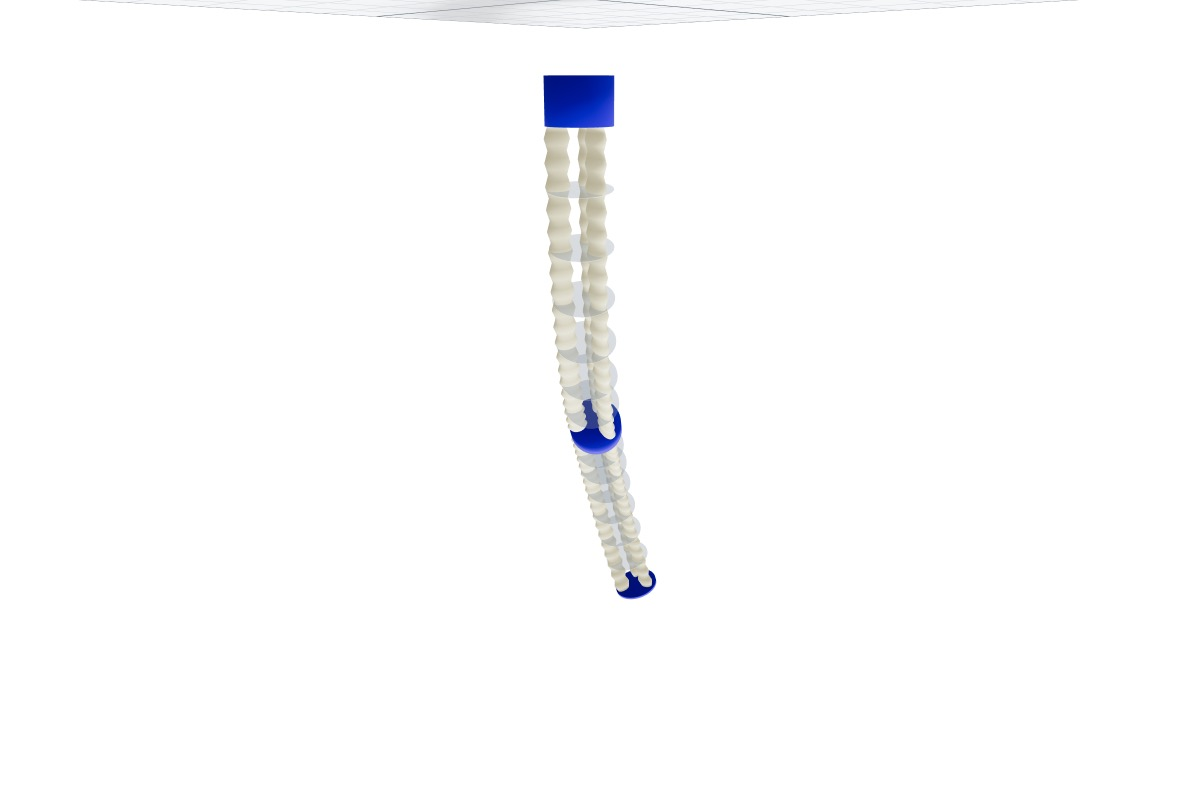
Specialized Viser Rendering
Use ISupportViserRenderer to display the physical chamber layout instead of
the generic swept backbone. The renderer follows the model's chamber radii,
radial distances, angle offsets, pneumatic-segment grouping, and rigid connector
topology. It adds corrugated chamber surfaces, six translucent spacers per
pneumatic segment, and the base, intermediate, and tip interfaces.
from soromox.rendering import RendererConfig, GeometryConfig, ISupportViserRenderer, ISupportVisualConfig

renderer = ISupportViserRenderer(
    robot,
    visual_config=ISupportVisualConfig(),
    config=RendererConfig(geometry=GeometryConfig(num_points=50)),
)
renderer.show(q)
ISupportVisualConfig exposes spacer thickness, chamber ellipticity, bellows
pitch and amplitude, mesh resolution, colors, and spacer opacity. Rigid
segments and pneumatic-section spacers use their modeled radii; no visual-only
connector slots are added.
Pass chamber pressures in pascals to color each chamber with the sequential
Matplotlib Blues colormap. The default scale spans 0–300 kPa and omits the
palest 15% of the colormap so unpressurized chambers remain visible. Values
outside the configured scale are clamped. Pressure channels use segment-major
order: all chamber azimuth indices of the first pneumatic segment, followed by
those of the second segment, and so on.
The pressure_range configuration is expressed in pascals, matching the
model and pressure input API. Conversion to kPa happens only for sidebar and
label presentation.
Interactive views color the chambers whenever pressures are supplied. Pressure
text starts hidden and can be enabled with the Show pressure labels sidebar
checkbox. Labels use one-based model terminology and display values in kPa, for
example Segment 1 · Chamber 1 and 20.0 kPa. A captured frame has no
interactive sidebar, so render_frame(q, pressures=pressures) includes both
the colors and labels automatically. Omitting pressures retains the original
uniform chamber appearance and renders no pressure text.
For trajectories, pressures may be a constant (num_actuators,) vector, a
(T, num_actuators) time series, or a batched
(N, T, num_actuators) time series:
The live controller accepts synchronized updates through
push_state_with_pressures(q, pressures), a separate pressure_callback, or a
state callback that returns (q, pressures).
Model Quick Start
import jax.numpy as jnp
from soromox.systems import ISupport, ISupportParams, ISupportStructure, LinkSpec, PCS

reference = [0.0, 0.0, 0.0, 1.0, 0.0, 0.0]
links = [
    # Physical order: rigid base, pneumatic section, rigid tip.
    LinkSpec.circular(
        length=length,
        radius=radius,
        density=density,
        young_modulus=young,
        shear_modulus=shear,
        material_damping_coefficient=1.96e3,
        reference_strain=reference,
    )
    for length, radius, density, young, shear in zip(
        [0.01, 0.18, 0.01],
        [0.03, 35.6e-3, 0.025],
        [1210.0, 1104.0, 1210.0],
        [2.0e9, 1.6464e6, 2.0e9],
        [0.8e9, 0.5488e6, 0.8e9],
    )
]
params = ISupportParams(
    link=PCS.params_from_links(links).link,
    chamber_inner_radius=jnp.array([6.39e-3]),
    chamber_outer_radius=jnp.array([7.79e-3]),
    chamber_distance=jnp.array([20e-3]),
    chamber_azimuth_angles=(2.0 * jnp.pi * jnp.arange(3) / 3)[None, :],
)
robot = ISupport(
    params,
    structure=ISupportStructure(
        num_gauss_points=3,
        rigid_segment_selector=(True, False, True),
    ),
)

q = jnp.zeros(robot.num_coordinates)

# Pressure actuation (3 chambers per pneumatic segment)
u = jnp.array([2.0e4, 0.0, 0.0])

# Forward kinematics
g_tip = robot.forward_kinematics(q, s=jnp.sum(robot.L))
Key Features
Chamber Configuration
The I-Support robot uses 3 pneumatic chambers per segment, arranged radially at 120-degree intervals. This configuration enables:
chamber_azimuth_angles has shape
(num_pneumatic_segments, num_chambers_per_segment). Azimuth is a
right-handed rotation about local +X, measured in radians from local +Y
toward local +Z, so a chamber center is
[0, d*cos(phi), d*sin(phi)]. Entry j is pressure channel j; the model
does not sort or generate angles. Each row may be rotated, wrapped, and listed
in any channel order, but its wrapped circular gaps must be uniformly
2*pi/num_chambers_per_segment (within rtol=1e-6, atol=1e-8). Asymmetric
layouts are currently rejected because the passive cross-section model assumes
rotational symmetry.
If chamber_azimuth_angles is omitted, ISupport supplies the canonical
three-chamber layout [0, 2*pi/3, 4*pi/3], or [0°, 120°, 240°], for every
pneumatic segment. Pass an explicit array whenever physical pressure-channel
order differs from that default.
- Bending in any direction
- Extension/compression along the backbone
- Complex 3D deformations
Actuation Mapping
Pressure remains the user control and is measured in pascals. The work
coordinate of chamber k is the equivalent chamber volume
so the pressure actuation matrix is
This is the same distributed virtual-path model introduced in PR #116, now
expressed through ThreadlikeActuator.pressure_chambers(...). It is
configuration-dependent and integrates the path contribution along every PCS
child belonging to the physical pneumatic section. A chamber never crosses a
rigid connector or contributes to another pneumatic section.
chamber_effective_pressure_area has one entry per physical pneumatic section
and is shared by its pressure channels. If omitted, the model uses the annular
area
The pressure-conjugate coordinates, velocities, efforts, moment matrix, and generalized force use the shared actuation interface:
volumes = robot.actuator_coordinates(q)
volume_rates = robot.actuator_velocities(q, qd)
pressure_efforts = robot.actuator_efforts(q, pressures, qd=qd)
A = robot.actuation_matrix(q)
tau = robot.actuation_force(q, pressures, qd=qd)
For the current DirectEffort model, pressure_efforts == pressures. The
effective area is part of the transmission coordinate and moment matrix rather
than a separate pressure-to-force conversion API.
I-SUPPORT's specialized renderer continues to draw the detailed bellows and
accepts actuator_inputs= (with pressures= as a mutually exclusive alias).
The internal equivalent paths are not drawn as generic pneumatic tubes.
API Reference
ISupport(params: ISupportParams, structure: ISupportStructure | None = None, **kwargs: Any)
Bases: PCS
              flowchart TD
              soromox.systems.pcs.isupport.ISupport[ISupport]
              soromox.systems.pcs.pcs.PCS[PCS]
              soromox.systems.soft_robot.SoftRobot[SoftRobot]
              soromox.systems.dynamical_system.DynamicalSystem[DynamicalSystem]

                              soromox.systems.pcs.pcs.PCS --> soromox.systems.pcs.isupport.ISupport
                                soromox.systems.soft_robot.SoftRobot --> soromox.systems.pcs.pcs.PCS
                                soromox.systems.dynamical_system.DynamicalSystem --> soromox.systems.soft_robot.SoftRobot


              click soromox.systems.pcs.isupport.ISupport href "" "soromox.systems.pcs.isupport.ISupport"
              click soromox.systems.pcs.pcs.PCS href "" "soromox.systems.pcs.pcs.PCS"
              click soromox.systems.soft_robot.SoftRobot href "" "soromox.systems.soft_robot.SoftRobot"
              click soromox.systems.dynamical_system.DynamicalSystem href "" "soromox.systems.dynamical_system.DynamicalSystem"
A kinematic and dynamic model for the (AM) I-Support robot based on the Piecewise Constant Strain shape parametrization.
Attributes:
| Name | Type | Description |
|---|---|---|
num_segments |
int
|
Number of segments (constant strain sections) along the robot. |
num_actuators |
int
|
Number of actuators (control inputs) for the robot. |
g0 |
Array
|
Initial pose of the robot base as an SE(3) transformation matrix. |
g |
Array
|
Gravitational acceleration vector (embedded in a 6D vector). [0, 0, 0, g_x, g_y, g_z] |
length |
Array
|
Length of each segment [m], cached as |
radius |
Array
|
Radius of each segment [m], cached as |
young_modulus |
Array
|
Elastic modulus of each segment [Pa], cached as |
shear_modulus |
Array
|
Shear modulus of each segment [Pa], cached as |
density |
Array
|
Density of each segment [kg/m^3], cached as |
damping_matrix |
Array
|
Resolved damping matrix of the flattened strain
coordinates, cached as |
num_active_strains |
Array
|
Number of active strain components (based on strain_selector). |
num_strains |
int
|
Total number of strain components (6 * num_segments). |
B_xi |
Array
|
Basis matrix for projecting active strains (6 * num_segments, num_active_strains). |
xi_ref |
Array
|
Reference strain (reference configuration) of the robot. |
num_gauss_points |
int
|
Requested nonzero Gauss-Legendre quadrature nodes. |
num_integration_points |
int
|
Stored integration nodes, including zero-weight endpoints. |
integration_points, |
integration_weights
|
Quadrature nodes and weights. |
chamber_inner_radius |
integration_weights
|
Inner radius of each segment's actuator [m],
cached as |
chamber_outer_radius |
integration_weights
|
Outer radius of each segment's actuator [m],
cached as |
chamber_distance |
integration_weights
|
Radial distance of the center of the actuators from
the centerline of the backbone [m], cached as |
chamber_azimuth_angles |
Array
|
Explicit chamber azimuths [rad], right-handed about local +X from +Y toward +Z. The second axis is pressure-channel order. |
References
Arleo, L., Stano, G., Percoco, G., & Cianchetti, M. (2021). I-support soft arm for assistance tasks: a new manufacturing approach based on 3D printing and characterization. Progress in Additive Manufacturing, 6(2), 243-256. https://doi.org/10.1007/s40964-020-00158-y
Alessi, C., Falotico, E., & Lucantonio, A. (2023). Ablation study of a dynamic model for a 3D-printed pneumatic soft robotic arm. IEEE Access, 11, 37840-37853. https://doi.org/10.1109/ACCESS.2023.3266282
Alessi, C., Bianchi, D., Stano, G., Cianchetti, M., & Falotico, E. (2024). Pushing with soft robotic arms via deep reinforcement learning. Advanced Intelligent Systems, 6(8), 2300899. https://doi.org/10.1002/aisy.202300899
Initialize an I-SUPPORT model from typed parameters.
Parameters:
| Name | Type | Description | Default |
|---|---|---|---|
params
|
ISupportParams
|
Dynamic I-SUPPORT parameters. |
required |
structure
|
ISupportStructure | None
|
Static I-SUPPORT layout. If omitted, physical segments alternate rigid and pneumatic from index zero, and each pneumatic segment is represented by one PCS segment. |
None
|
**kwargs
|
Any
|
Additional keyword arguments forwarded to :class: |
{}
|
Raises:
| Type | Description |
|---|---|
TypeError
|
If |
ValueError
|
If the physical layout, chamber geometry, expanded PCS parameters, or an inherited constructor option is invalid. |
property

Epsilon value for Lie algebra tangent computations.
Returns:
| Name | Type | Description |
|---|---|---|
Array |
Array
|
Epsilon value for Lie algebra tangent computations. |
property

Return the configuration-storage dimension of the base.
Returns:
| Type | Description |
|---|---|
int
|
Zero for fixed robots, three for planar floating robots, and seven |
int
|
for spatial floating robots. |
property

Return the generalized-velocity dimension of the base.
Returns:
| Type | Description |
|---|---|
int
|
Zero for fixed robots, three for planar floating robots, and six |
int
|
for spatial floating robots. |
property

Return the total configuration dimension.
Returns:
| Type | Description |
|---|---|
int
|
|
property

Return the total generalized-velocity dimension.
Returns:
| Type | Description |
|---|---|
int
|
|
property

Return the number of trailing first-order auxiliary states.
Returns:
| Type | Description |
|---|---|
int
|
The hysteresis-state dimension, or zero for systems without |
int
|
auxiliary dynamics. |
property

Return the flattened first-order state dimension.
Returns:
| Type | Description |
|---|---|
int
|
|
property

actuator_input_metadata: tuple[ActuatorMetadata, ...]
Metadata groups in the same order used to concatenate controls.
property

Return the per-segment backbone lengths.
Returns:
| Type | Description |
|---|---|
Array
|
Array with shape |
property

Return whether the system is planar.
Returns:
| Type | Description |
|---|---|
bool
|
Always |
property

Whether joint indices describe a serial articulated routing topology.
property

Return the homogeneous transform of the fixed/internal base pose.
Planar robots consume [theta, x, y] and return an SE(2) matrix with
shape (3, 3). Spatial robots consume
[qx, qy, qz, qw, x, y, z] and return an SE(3) matrix with shape
(4, 4). Spatial quaternions are scalar-last Hamilton quaternions.
with_params(params: ISupportParams) -> ISupport
Return a copy using complete physical-segment parameters.
The physical I-SUPPORT layout is expanded back into PCS segments, and inherited geometry, dynamics, and actuation caches are refreshed.
Parameters:
| Name | Type | Description | Default |
|---|---|---|---|
params
|
ISupportParams
|
Complete replacement :class: |
required |
Returns:
| Type | Description |
|---|---|
ISupport
|
A new I-SUPPORT model containing the replacements. The original |
ISupport
|
model is unchanged. |
Raises:
| Type | Description |
|---|---|
TypeError
|
If |
ValueError
|
If validation fails or the replacement changes a static layout choice such as the number of chambers. |
update_params(**updates: Array) -> ISupport
Return a copy with selected physical parameter fields replaced.
Parameters:
| Name | Type | Description | Default |
|---|---|---|---|
**updates
|
Array
|
Fields of :class: |
{}
|
Returns:
| Type | Description |
|---|---|
ISupport
|
A new validated I-SUPPORT model with refreshed PCS and actuator |
ISupport
|
caches. |
Raises:
| Type | Description |
|---|---|
KeyError
|
If an update names an unknown parameter field. |
TypeError
|
If a replacement has an invalid type. |
ValueError
|
If the resulting parameters are invalid or incompatible with the static physical layout. |
Return one azimuth per chamber in pressure-channel order.
This concise accessor name is distinct from the parameter field
chamber_azimuth_angles. The returned array has shape
(num_chambers_per_segment,) and is not sorted or normalized.
Parameters:
| Name | Type | Description | Default |
|---|---|---|---|
pneumatic_segment_idx
|
Array
|
Index of the physical pneumatic segment. |
required |
Returns:
| Type | Description |
|---|---|
Array
|
Chamber azimuth angles in radians, indexed exactly like the |
Array
|
segment's pressure inputs. |
Return vectors from the local backbone centerline to chamber centers.
The result has shape (num_chambers_per_segment, 3) and follows
pressure-channel order. Each row is expressed in the pneumatic
segment's local frame as [0, d*cos(phi), d*sin(phi)]; it is an
offset vector, not an absolute chamber-center position.
Parameters:
| Name | Type | Description | Default |
|---|---|---|---|
pneumatic_segment_idx
|
Array
|
Index of the physical pneumatic segment. |
required |
Returns:
| Type | Description |
|---|---|
Array
|
Local chamber-center offset vectors in meters. |
Return generic actuator layers for rendering.
I-SUPPORT's chamber-center paths represent equivalent pressure-volume coordinates rather than physical tendons, so generic renderers should not draw them.
Parameters:
| Name | Type | Description | Default |
|---|---|---|---|
q
|
Array
|
Generalized coordinates accepted by the common rendering API. |
required |
s_points
|
Array
|
Backbone sampling coordinates accepted by the common rendering API. |
required |
actuator_inputs
|
Array | None
|
Optional actuator inputs accepted by the common rendering API. |
None
|
Returns:
| Type | Description |
|---|---|
tuple
|
An empty tuple. |
forward_dynamics(t: Array, y: Array, actuation_args: tuple | None = None, *, backend: ExecutionBackend | None = None) -> Array
Compute the time derivative of a spatial PCS state.
Parameters:
| Name | Type | Description | Default |
|---|---|---|---|
t
|
Array
|
Current integration time. PCS dynamics are autonomous, so the value is accepted for solver compatibility but is not otherwise used. |
required |
y
|
Array
|
State |
required |
actuation_args
|
tuple | None
|
Optional tuple containing the actuation input |
None
|
backend
|
ExecutionBackend | None
|
Optional execution-backend override for the inertia,
Coriolis, and gravity terms. |
None
|
Returns:
| Type | Description |
|---|---|
Array
|
State derivative |
Raises:
| Type | Description |
|---|---|
ValueError
|
If |
Project a state onto the robot's configuration manifold.
Fixed and planar systems return the original state without additional array operations. Spatial floating systems normalize the leading scalar-last quaternion while preserving velocity and auxiliary state.
Parameters:
| Name | Type | Description | Default |
|---|---|---|---|
y
|
Array
|
State with trailing dimension |
required |
Returns:
| Type | Description |
|---|---|
Array
|
State with a unit floating-base quaternion when applicable. |
rollout_to(initial_state: SystemState, u: Array | None = None, tau_ext: Array | None = None, environment_model: Callable[[SystemState], tuple[Array | None, Any | None]] | None = None, t1: float | Array = 10.0, solver_dt: float | Array = 0.0001, save_dt: float | Array | None = 0.01, save_ts: Array | Sequence[float] | None = None, solver: AbstractSolver | None = None, stepsize_controller: AbstractStepSizeController | None = ConstantStepSize(), max_steps: int | None = None) -> SystemState
Roll out the system dynamics in open loop using Diffrax.
Parameters:
| Name | Type | Description | Default |
|---|---|---|---|
initial_state
|
SystemState
|
Dataclass holding the initial time, system state vector (y), optional actuation (u), and optional control state. |
required |
u
|
Array | None
|
Constant actuation to apply throughout the rollout. If not provided,
falls back to |
None
|
tau_ext
|
Array | None
|
External forces/torques applied to the system (broadcast as constant). |
None
|
environment_model
|
Callable[[SystemState], tuple[Array | None, Any | None]] | None
|
Optional callable that accepts a |
None
|
t1
|
float | Array
|
Final time of the simulation, included in the saved trajectory. |
10.0
|
solver_dt
|
float | Array
|
Time step for the solver. |
0.0001
|
save_dt
|
float | Array | None
|
Time interval at which to save the solution when |
0.01
|
save_ts
|
Array | Sequence[float] | None
|
Explicit time points to be saved in the output. Must be within
[initial_state.t, t1]. Falls back to |
None
|
solver
|
AbstractSolver | None
|
Solver to use for the ODE integration. |
None
|
stepsize_controller
|
AbstractStepSizeController | None
|
Stepsize controller for the solver. |
ConstantStepSize()
|
max_steps
|
int | None
|
Maximum number of steps for the solver. |
None
|
Returns:
| Type | Description |
|---|---|
SystemState
|
SystemState PyTree containing time samples, system state trajectory, |
SystemState
|
actuation at each saved step, (optionally) the control state |
SystemState
|
trajectory, and (optionally) the environment state trajectory if |
SystemState
|
|
SystemState
|
leading time dimension aligned with |
rollout_closed_loop_to(initial_state: SystemState, controller: Callable[[SystemState], tuple[Array, Any | None]], tau_ext: Array | None = None, environment_model: Callable[[SystemState], tuple[Array | None, Any | None]] | None = None, t1: float | Array = 10.0, solver_dt: float | Array = 0.0001, save_dt: float | Array | None = 0.01, save_ts: Array | Sequence[float] | None = None, solver: AbstractSolver | None = None, stepsize_controller: AbstractStepSizeController | None = ConstantStepSize(), max_steps: int | None = None) -> SystemState
Roll out the system dynamics in closed loop using Diffrax.
The provided controller is queried at every integration step with the current
system state (and optional control_state). Its actuation output is added to any
feed-forward actuation contained in initial_state.u.
Parameters:
| Name | Type | Description | Default |
|---|---|---|---|
initial_state
|
SystemState
|
Dataclass holding the initial time, system state vector (y), optional actuation (u), and optional control state. |
required |
controller
|
Callable[[SystemState], tuple[Array, Any | None]]
|
Callable that accepts a |
required |
tau_ext
|
Array | None
|
External forces/torques applied to the system (broadcast as constant). |
None
|
environment_model
|
Callable[[SystemState], tuple[Array | None, Any | None]] | None
|
Optional callable that accepts a |
None
|
t1
|
float | Array
|
Final time of the simulation, included in the saved trajectory. |
10.0
|
solver_dt
|
float | Array
|
Time step for the solver. |
0.0001
|
save_dt
|
float | Array | None
|
Time interval at which to save the solution when |
0.01
|
save_ts
|
Array | Sequence[float] | None
|
Explicit time points to be saved in the output. Must be within
[initial_state.t, t1]. Falls back to |
None
|
solver
|
AbstractSolver | None
|
Solver to use for the ODE integration. |
None
|
stepsize_controller
|
AbstractStepSizeController | None
|
Stepsize controller for the solver. |
ConstantStepSize()
|
max_steps
|
int | None
|
Maximum number of steps for the solver. |
None
|
Returns:
| Type | Description |
|---|---|
SystemState
|
SystemState PyTree containing time samples, system state trajectory, |
SystemState
|
actuation at each saved step, controller state trajectory, and |
SystemState
|
(optionally) the environment state trajectory if |
SystemState
|
|
SystemState
|
leading time dimension aligned with |
rollout_discrete_closed_loop_to(initial_state: SystemState, controller: Callable[[SystemState], tuple[Array, Any | None]], tau_ext: Array | None = None, environment_model: Callable[[SystemState], tuple[Array | None, Any | None]] | None = None, duration: float = 10.0, solver_dt: float | Array = 0.0001, control_dt: float = 0.01, save_dt: float = 0.01, solver: AbstractSolver | None = None, stepsize_controller: AbstractStepSizeController | None = ConstantStepSize(), max_steps: int | None = None) -> SystemState
Roll out the system in discrete-time closed loop.
The controller is evaluated every control_dt seconds. Between control
evaluations the actuation is held constant and the system is integrated
with Diffrax (equivalent to repeatedly calling rollout_to over each
control interval).
The controller signature mirrors rollout_closed_loop_to. If it returns a
control_state_dot and initial_state.control_state is provided, the
control state is advanced with a forward-Euler step over the control period;
otherwise the control state is held constant between controller calls.
The rollout uses a regular time grid. For static tracing/compilation the
following constraints are enforced:
- duration is an integer multiple of control_dt.
- control_dt is an integer multiple of save_dt.
Parameters:
| Name | Type | Description | Default |
|---|---|---|---|
initial_state
|
SystemState
|
initial time/state (and optional feedforward actuation/control state). |
required |
controller
|
Callable[[SystemState], tuple[Array, Any | None]]
|
callable returning |
required |
tau_ext
|
Array | None
|
constant external wrench/force applied during the rollout. |
None
|
environment_model
|
Callable[[SystemState], tuple[Array | None, Any | None]] | None
|
Optional callable returning
|
None
|
duration
|
float
|
simulation duration in seconds. |
10.0
|
solver_dt
|
float | Array
|
initial step size for the solver. |
0.0001
|
control_dt
|
float
|
sampling period for the controller. Must be positive. |
0.01
|
save_dt
|
float
|
save interval. Must be positive and evenly divide |
0.01
|
solver
|
AbstractSolver | None
|
Diffrax solver. |
None
|
stepsize_controller
|
AbstractStepSizeController | None
|
Diffrax stepsize controller. |
ConstantStepSize()
|
max_steps
|
int | None
|
maximum solver steps. |
None
|
Returns:
| Type | Description |
|---|---|
SystemState
|
SystemState PyTree containing time samples, system state trajectory, |
SystemState
|
actuation at each saved step, controller state trajectory, and |
SystemState
|
(optionally) the environment state trajectory if |
SystemState
|
|
SystemState
|
leading time dimension aligned with the regular save grid. |
Pack internal coordinates and a runtime base pose.
Parameters:
| Name | Type | Description | Default |
|---|---|---|---|
q_internal
|
Array
|
Internal coordinates with trailing dimension
|
required |
base_pose
|
Array | None
|
Required runtime pose for floating robots. Fixed robots reject this argument. |
None
|
Returns:
| Type | Description |
|---|---|
Array
|
Total configuration with trailing dimension |
Raises:
| Type | Description |
|---|---|
ValueError
|
If a required base pose is missing, a fixed robot is given a runtime pose, or a trailing dimension is invalid. |
Split total configuration into base and internal coordinates.
Parameters:
| Name | Type | Description | Default |
|---|---|---|---|
q
|
Array
|
Configuration with trailing dimension |
required |
Returns:
| Type | Description |
|---|---|
tuple[Array | None, Array]
|
|
Pack internal and floating-base generalized velocities.
Parameters:
| Name | Type | Description | Default |
|---|---|---|---|
qd_internal
|
Array
|
Internal generalized velocity with trailing dimension
|
required |
base_velocity
|
Array | None
|
Optional world-frame base velocity. Omission uses zero for floating robots; fixed robots reject this argument. |
None
|
Returns:
| Type | Description |
|---|---|
Array
|
Total generalized velocity with trailing dimension |
Array
|
|
Raises:
| Type | Description |
|---|---|
ValueError
|
If a fixed robot is given a base velocity or a trailing dimension is invalid. |
Split total velocity into base and internal components.
Parameters:
| Name | Type | Description | Default |
|---|---|---|---|
v
|
Array
|
Generalized velocity with trailing dimension |
required |
Returns:
| Type | Description |
|---|---|
tuple[Array | None, Array]
|
|
Pack configuration, velocity, and optional auxiliary state.
Parameters:
| Name | Type | Description | Default |
|---|---|---|---|
q
|
Array
|
Configuration with trailing dimension |
required |
v
|
Array
|
Velocity with trailing dimension |
required |
auxiliary_state
|
Array | None
|
Optional state with trailing dimension
|
None
|
Returns:
| Type | Description |
|---|---|
Array
|
State |
Array
|
dimension |
Split a state with unequal configuration and velocity dimensions.
Parameters:
| Name | Type | Description | Default |
|---|---|---|---|
y
|
Array
|
State with trailing dimension |
required |
Returns:
| Type | Description |
|---|---|
tuple[Array, Array, Array]
|
|
Normalize a floating spatial quaternion without changing hemisphere.
Parameters:
| Name | Type | Description | Default |
|---|---|---|---|
q
|
Array
|
Configuration with trailing dimension |
required |
Returns:
| Type | Description |
|---|---|
Array
|
The unchanged input for fixed or planar robots, or a configuration |
Array
|
whose leading scalar-last quaternion has unit norm. |
Raises:
| Type | Description |
|---|---|
ValueError
|
If a concrete spatial quaternion is zero or non-finite. |
Map generalized velocity to the derivative of stored coordinates.
Parameters:
| Name | Type | Description | Default |
|---|---|---|---|
q
|
Array
|
Configuration with trailing dimension |
required |
v
|
Array
|
Velocity with trailing dimension |
required |
Returns:
| Type | Description |
|---|---|
Array
|
|
Array
|
angular velocity is world-frame and left-multiplies the quaternion. |
Retract a velocity-space increment onto configuration space.
Parameters:
| Name | Type | Description | Default |
|---|---|---|---|
q
|
Array
|
Configuration with trailing dimension |
required |
delta_v
|
Array
|
Tangent increment with trailing dimension
|
required |
Returns:
| Type | Description |
|---|---|
Array
|
Updated configuration. Spatial rotation increments left-multiply |
Array
|
the scalar-last quaternion and the result is normalized. |
Convert the runtime or fixed base pose to homogeneous transforms.
Parameters:
| Name | Type | Description | Default |
|---|---|---|---|
q
|
Array
|
Total configuration for floating robots or internal configuration for fixed robots. |
required |
Returns:
| Type | Description |
|---|---|
Array
|
A planar |
Return a fixed robot with a different mounting pose.
Parameters:
| Name | Type | Description | Default |
|---|---|---|---|
pose
|
Array
|
Planar pose with shape |
required |
Returns:
| Type | Description |
|---|---|
Self
|
A functionally updated robot with mounting-dependent caches refreshed. |
Raises:
| Type | Description |
|---|---|
ValueError
|
If the robot is floating or the pose is invalid. |
Refresh state-independent matrices cached by the model.
Returns:
| Type | Description |
|---|---|
None
|
|
None
|
and active-coordinate matrices are replaced in place. |
Return a robot with one actuator's complete parameter object replaced.
Return a robot with selected fields of one actuator's params replaced.
Return a robot with one passive element's complete params replaced.
Return a robot with selected passive-element parameter fields replaced.
Evaluate the circular cross-section at a backbone coordinate.
Parameters:
| Name | Type | Description | Default |
|---|---|---|---|
q
|
Array
|
Generalized coordinates. PCS cross-section geometry is
configuration-independent, but |
required |
s
|
Array
|
Scalar global backbone coordinate. |
required |
Returns:
| Type | Description |
|---|---|
Array
|
A tuple containing the circular :class: |
Array
|
and a one-element array holding the selected segment radius. |
Raises:
| Type | Description |
|---|---|
ValueError
|
If |
forward_kinematics(q: Array, s: Array, *, backend: ExecutionBackend | None = None) -> Array
Compute an SE(3) pose at one curvilinear abscissa.
Parameters:
| Name | Type | Description | Default |
|---|---|---|---|
q
|
Array
|
Active generalized strains with shape |
required |
s
|
Array
|
Scalar curvilinear abscissa. |
required |
backend
|
ExecutionBackend | None
|
Optional execution override. |
None
|
Returns:
| Type | Description |
|---|---|
Array
|
Homogeneous transform with shape |
Compute the forward kinematics of the robot at all segment tips.
Parameters:
| Name | Type | Description | Default |
|---|---|---|---|
q
|
Array
|
generalized coordinates of shape (num_active_strains,). |
required |
Returns:
| Name | Type | Description |
|---|---|---|
g_tips |
Array
|
forward kinematics of the robot at all segment tips, shape (num_segments, 4, 4) : g_tip_i = [[ R, p], [0, 0, 0, 1]] where R is the rotation matrix and p is the position vector. |
forward_kinematics_abscissa_batched(q: Array, s_ps: Array, *, backend: ExecutionBackend | None = None) -> Array
Compute SE(3) poses at a batch of curvilinear abscissae.
Parameters:
| Name | Type | Description | Default |
|---|---|---|---|
q
|
Array
|
Active generalized strains with shape |
required |
s_ps
|
Array
|
Curvilinear abscissae with shape |
required |
backend
|
ExecutionBackend | None
|
Optional execution override. |
None
|
Returns:
| Type | Description |
|---|---|
Array
|
Homogeneous transforms with shape |
Compute the arc-length derivative of the forward kinematics at s.
The returned tangent has the same shape and representation as
forward_kinematics(q, s).
Compute forward kinematics and its arc-length derivative at s.
Subclasses can override the protected hook to share intermediate
kinematic quantities between the primal pose and d pose / ds.
Compute the Jacobian of the forward kinematics at a point s along the robot.
The Jacobian maps configuration space velocities to operational space (Cartesian/task space) velocities at point s.
Parameters:
| Name | Type | Description | Default |
|---|---|---|---|
q
|
Array
|
Generalized coordinates of shape (num_coordinates,). |
required |
s
|
Array
|
Position parameter along the robot structure. |
required |
Returns:
| Name | Type | Description |
|---|---|---|
J |
Array
|
Jacobian matrix of shape (n_pose_dim, num_velocities), where n_pose_dim depends on the robot type: - For 3D robots (PCS): 6 (angular velocity + linear velocity) - For planar robots (PlanarPCS, Pendulum): 3 (omega_z, v_x, v_y) |
Compute inertial-frame Jacobians at all segment tips.
Parameters:
| Name | Type | Description | Default |
|---|---|---|---|
q
|
Array
|
generalized coordinates of shape (num_active_strains,). |
required |
Returns:
| Name | Type | Description |
|---|---|---|
J_tips |
Array
|
inertial-frame Jacobians at each segment tip, shape (num_segments, 6, num_active_strains). |
Compute inertial-frame Jacobians at multiple arc-length positions.
Parameters:
| Name | Type | Description | Default |
|---|---|---|---|
q
|
Array
|
Active generalized strains with shape
|
required |
s_ps
|
Array
|
Backbone coordinates with shape |
required |
Returns:
| Type | Description |
|---|---|
Array
|
Inertial-frame Jacobians with shape |
Array
|
|
Compute the arc-length derivative of the Jacobian at s.
The returned derivative has the same shape and frame convention as
jacobian(q, s).
Compute the Jacobian and its arc-length derivative at s.
Returns:
| Name | Type | Description |
|---|---|---|
J |
Array
|
Jacobian matrix of shape (n_pose_dim, num_velocities). |
Js |
Array
|
Arc-length derivative of the Jacobian with the same shape as |
Compute the Jacobian and its time derivative at a point s along the robot.
Parameters:
| Name | Type | Description | Default |
|---|---|---|---|
q
|
Array
|
Generalized coordinates of shape (num_coordinates,). |
required |
qd
|
Array
|
Generalized velocities of shape (num_velocities,). |
required |
s
|
Array
|
Position parameter along the robot structure. |
required |
Returns:
| Name | Type | Description |
|---|---|---|
J |
Array
|
Jacobian matrix of shape (n_pose_dim, num_velocities). |
Jd |
Array
|
Time derivative of the Jacobian, shape (n_pose_dim, num_velocities). |
jacobian_and_time_derivative_abscissa_batched(q: Array, qd: Array, s_ps: Array) -> tuple[Array, Array]
Compute batched inertial Jacobians and their time derivatives.
Parameters:
| Name | Type | Description | Default |
|---|---|---|---|
q
|
Array
|
Active generalized strains with shape
|
required |
qd
|
Array
|
Active generalized strain rates with shape
|
required |
s_ps
|
Array
|
Backbone coordinates with shape |
required |
Returns:
| Type | Description |
|---|---|
Array
|
A tuple |
Array
|
|
Compute the Jacobian of the forward kinematics at a point s along the robot in the body frame.
Parameters:
| Name | Type | Description | Default |
|---|---|---|---|
q
|
Array
|
generalized coordinates of shape (num_active_strains,). |
required |
s
|
Array
|
point coordinate along the robot in the interval [0, L]. |
required |
Returns:
| Name | Type | Description |
|---|---|---|
J_local |
Array
|
Jacobian of the forward kinematics at point s in the body frame, shape (6, num_active_strains) |
Compute the Jacobian of the forward kinematics at a batch of points s_ps along the robot in the body frame.
Parameters:
| Name | Type | Description | Default |
|---|---|---|---|
q
|
Array
|
generalized coordinates of shape (num_active_strains,). |
required |
s_ps
|
Array
|
point coordinates along the robot in the interval [0, L] of shape (N,). |
required |
Returns:
| Name | Type | Description |
|---|---|---|
J_local_ps |
Array
|
Jacobians evaluated at all points, shape (N, 6, num_active_strains) |
Compute the Jacobian and its time-derivative for the forward kinematics at a point s along the robot in the body frame.
Parameters:
| Name | Type | Description | Default |
|---|---|---|---|
q
|
Array
|
generalized coordinates of shape (num_active_strains,). |
required |
qd
|
Array
|
time-derivative of the generalized coordinates of shape (num_active_strains,). |
required |
s
|
Array
|
point coordinate along the robot in the interval [0, L]. |
required |
Returns:
| Name | Type | Description |
|---|---|---|
J_local |
Array
|
Jacobian of the forward kinematics at point s in the body frame, shape (6, num_active_strains) |
Jd_local |
Array
|
Time-derivative of the Jacobian at point s in the body frame, shape (6, num_active_strains) |
jacobian_and_time_derivative_bodyframe_abscissa_batched(q: Array, qd: Array, s_ps: Array) -> tuple[Array, Array]
Compute the Jacobian and its time-derivative for the forward kinematics at a batch of points s_ps along the robot in the body frame.
Parameters:
| Name | Type | Description | Default |
|---|---|---|---|
q
|
Array
|
generalized coordinates of shape (num_active_strains,). |
required |
qd
|
Array
|
time-derivative of the generalized coordinates of shape (num_active_strains,). |
required |
s_ps
|
Array
|
point coordinates along the robot in the interval [0, L] of shape (N,). |
required |
Returns:
| Name | Type | Description |
|---|---|---|
J_local_ps |
Array
|
Jacobians evaluated at all points, shape (N, 6, num_active_strains) |
Jd_local_ps |
Array
|
Time-derivative of the Jacobians, shape (N, 6, num_active_strains) |
Return integration-point kinematics in active generalized coordinates.
The stored quadrature grid includes zero-weight endpoint nodes; this method ignores those endpoints and evaluates only the nonzero-weight interior quadrature nodes. The coordinates are generalized coordinates for active strain components only.
Parameters:
| Name | Type | Description | Default |
|---|---|---|---|
q
|
Array
|
Active generalized coordinates, shape |
required |
qd
|
Array
|
Active generalized velocities, shape |
required |
Returns:
| Type | Description |
|---|---|
Array
|
Tuple |
Array
|
shape |
Array
|
|
tuple[Array, Array, Array]
|
coordinates with shape |
tuple[Array, Array, Array]
|
|
tuple[Array, Array, Array]
|
|
tuple[Array, Array, Array]
|
|
Compute the inertia matrix of the robot.
Parameters:
| Name | Type | Description | Default |
|---|---|---|---|
q
|
Array
|
generalized coordinates of shape (num_active_strains,). |
required |
Returns:
| Name | Type | Description |
|---|---|---|
B |
Array
|
Inertia matrix of shape (num_active_strains, num_active_strains). |
Compute the Coriolis matrix of the robot.
Parameters:
| Name | Type | Description | Default |
|---|---|---|---|
q
|
Array
|
generalized coordinates of shape (num_active_strains,). |
required |
qd
|
Array
|
time-derivative of the generalized coordinates of shape (num_active_strains,). |
required |
Returns:
| Name | Type | Description |
|---|---|---|
C |
Array
|
Coriolis matrix of shape (num_active_strains, num_active_strains). |
Compute the damping matrix of the robot.
Parameters:
| Name | Type | Description | Default |
|---|---|---|---|
q
|
Array
|
generalized coordinates of shape (num_active_strains,). |
required |
Returns:
| Name | Type | Description |
|---|---|---|
D |
Array
|
Damping matrix of shape (num_active_strains, num_active_strains). |
Compute the stiffness matrix of the robot.
Returns:
| Name | Type | Description |
|---|---|---|
K |
Array
|
Stiffness matrix of shape (num_active_strains, num_active_strains). |
Compute the elastic forces of the robot.
Parameters:
| Name | Type | Description | Default |
|---|---|---|---|
q
|
Array
|
generalized coordinates of shape (num_active_strains,). |
required |
Returns:
| Name | Type | Description |
|---|---|---|
tau_el |
Array
|
Elastic force of shape (num_active_strains,). |
Compute the gravitational force.
Parameters:
| Name | Type | Description | Default |
|---|---|---|---|
q
|
Array
|
Generalized coordinates of shape (num_coordinates,). |
required |
Returns:
| Name | Type | Description |
|---|---|---|
G |
Array
|
Gravitational force of shape (num_velocities,). |
Compute the total conservative generalized force.
This is the sum of gravitational and elastic forces.
Parameters:
| Name | Type | Description | Default |
|---|---|---|---|
q
|
Array
|
Generalized coordinates of shape (num_coordinates,). |
required |
Returns:
| Name | Type | Description |
|---|---|---|
tau_pot |
Array
|
Potential force of shape (num_velocities,). |
Return the installed transmissions' work-conjugate coordinates.
Coordinates are concatenated in actuator and channel order, matching
the columns of :meth:actuation_matrix and the entries returned by
:meth:actuator_efforts. Their physical units may differ between
actuator families, such as length for tendons or volume for pressure
actuation.
Parameters:
| Name | Type | Description | Default |
|---|---|---|---|
q
|
Array
|
Generalized coordinates of shape |
required |
Returns:
| Name | Type | Description |
|---|---|---|
y_a |
Array
|
Actuator coordinates of shape |
Return the installed transmissions' coordinate velocities.
Velocities are concatenated in actuator and channel order and satisfy
yd_a = A(q).T @ qd, where A(q) is the concatenated actuator
transmission matrix.
Parameters:
| Name | Type | Description | Default |
|---|---|---|---|
q
|
Array
|
Generalized coordinates of shape |
required |
qd
|
Array
|
Generalized velocities of shape |
required |
Returns:
| Name | Type | Description |
|---|---|---|
yd_a |
Array
|
Actuator-coordinate velocities of shape
|
actuation_matrix(q: Array, *, backend: ExecutionBackend | None = None) -> Array
Return the actuator matrix through the selected execution backend.
actuator_efforts(q: Array, u: Array, qd: Array | None = None, *, actuation_matrix: Array | None = None) -> Array
Map user controls to work-conjugate actuator efforts.
Controls and returned efforts follow the order of the installed
actuators. Effort models evaluate the actuator coordinates or
velocities only when those quantities are required. If an effort model
requires velocity and qd is omitted, zero generalized velocity is
used.
Parameters:
| Name | Type | Description | Default |
|---|---|---|---|
q
|
Array
|
Generalized coordinates of shape (num_coordinates,). |
required |
u
|
Array
|
Actuator controls of shape (num_actuators,). |
required |
qd
|
Array | None
|
Optional generalized velocities of shape (num_velocities,). |
None
|
actuation_matrix
|
Array | None
|
Optional precomputed actuator transmission matrix
with shape |
None
|
Returns:
| Name | Type | Description |
|---|---|---|
e |
Array
|
Work-conjugate actuator efforts of shape (num_actuators,). |
Raises:
| Type | Description |
|---|---|
ValueError
|
If |
actuation_force(q: Array, u: Array, qd: Array | None = None, *, backend: ExecutionBackend | None = None) -> Array
Return generalized actuator force through the selected backend.
Return the installed passive elements' elastic generalized force.
This method sums only composable passive-element contributions. System
implementations add the result to their intrinsic body elasticity when
evaluating :meth:elastic_force.
Parameters:
| Name | Type | Description | Default |
|---|---|---|---|
q
|
Array
|
Generalized coordinates of shape |
required |
Returns:
| Name | Type | Description |
|---|---|---|
tau_passive |
Array
|
Passive elastic generalized force of shape
|
Return the installed passive elements' generalized damping matrix.
This method sums only composable passive-element contributions. System
implementations add the result to their intrinsic body damping when
evaluating :meth:damping_matrix.
Parameters:
| Name | Type | Description | Default |
|---|---|---|---|
q
|
Array
|
Generalized coordinates of shape |
required |
Returns:
| Name | Type | Description |
|---|---|---|
D_passive |
Array
|
Passive damping matrix of shape
|
Return the installed passive elements' stored elastic energy.
This method sums only composable passive-element contributions. System implementations add the result to their intrinsic body strain energy when evaluating elastic or potential energy.
Parameters:
| Name | Type | Description | Default |
|---|---|---|---|
q
|
Array
|
Generalized coordinates of shape |
required |
Returns:
| Name | Type | Description |
|---|---|---|
U_passive |
Array
|
Scalar passive elastic energy. A robot without passive elements returns zero. |
Compute the kinetic energy of the system.
Default implementation: T = 0.5 * qd^T * M(q) * qd
Parameters:
| Name | Type | Description | Default |
|---|---|---|---|
q
|
Array
|
Generalized coordinates of shape (num_coordinates,). |
required |
qd
|
Array
|
Generalized velocities of shape (num_velocities,). |
required |
Returns:
| Name | Type | Description |
|---|---|---|
T |
Array
|
Kinetic energy (scalar). |
Compute the gravitational potential energy of the system.
Parameters:
| Name | Type | Description | Default |
|---|---|---|---|
q
|
Array
|
Generalized coordinates of shape (num_coordinates,). |
required |
Returns:
| Name | Type | Description |
|---|---|---|
U_g |
Array
|
Gravitational potential energy (scalar). |
Compute the elastic potential energy stored in the system.
Default implementation: U_el = 0.5 * q^T * K * q
Parameters:
| Name | Type | Description | Default |
|---|---|---|---|
q
|
Array
|
Generalized coordinates of shape (num_coordinates,). |
required |
Returns:
| Name | Type | Description |
|---|---|---|
U_el |
Array
|
Elastic potential energy (scalar). |
Compute the total potential energy of the system.
This is the sum of gravitational and elastic energy.
Parameters:
| Name | Type | Description | Default |
|---|---|---|---|
q
|
Array
|
Generalized coordinates of shape (num_coordinates,). |
required |
Returns:
| Name | Type | Description |
|---|---|---|
U |
Array
|
Total potential energy (scalar). |
Compute the total energy of the system.
This is the sum of kinetic and potential energy.
Parameters:
| Name | Type | Description | Default |
|---|---|---|---|
q
|
Array
|
Generalized coordinates of shape (num_coordinates,). |
required |
qd
|
Array
|
Generalized velocities of shape (num_velocities,). |
required |
Returns:
| Name | Type | Description |
|---|---|---|
E |
Array
|
Total energy (scalar). |
dynamics_terms(q: Array, qd: Array, *, backend: ExecutionBackend | None = None) -> tuple[Array, Array, Array]
Assemble spatial PCS dynamics terms for one or many environments.
backend=None uses the model's configured :attr:backend. Warp is
selected for forward-only GPU execution with any positive quadrature
count; CPU execution and all forward- or reverse-mode differentiation
use the JAX implementation. Applying :func:jax.vmap to scalar calls
invokes one batch-shaped Warp pipeline rather than mapping independent
batch-one launches.
The Warp implementation uses FP64 local constant-strain operators and
one persistent cooperative chain block per environment. Its generated
source is independent of the batch size and segment count. Install the
optional dependency with pip install soromox[warp] before explicitly
requesting it.
Parameters:
| Name | Type | Description | Default |
|---|---|---|---|
q
|
Array
|
Active generalized coordinates with shape |
required |
qd
|
Array
|
Active generalized velocities with the same shape as |
required |
backend
|
ExecutionBackend | None
|
Optional per-call override: |
None
|
Returns:
| Type | Description |
|---|---|
Array
|
Tuple |
Array
|
as the inputs. |
Array
|
Coriolis/centrifugal force action, and |
Raises:
| Type | Description |
|---|---|
ValueError
|
If the backend or input shapes are invalid, or a Warp batch is empty. |
TypeError
|
If Warp is selected for non-FP64 states. |
ImportError
|
If Warp is selected but |
staticmethod

params_from_links(links: list[LinkSpec] | tuple[LinkSpec, ...], *, gravity: Array | None = None) -> PCSParams
Build spatial PCS parameters from shared link specifications.
Parameters:
| Name | Type | Description | Default |
|---|---|---|---|
links
|
list[LinkSpec] | tuple[LinkSpec, ...]
|
Non-empty sequence of constant, circular link
specifications. Each reference strain must have shape |
required |
gravity
|
Array | None
|
Optional world-frame gravity vector with shape |
None
|
Returns:
| Name | Type | Description |
|---|---|---|
Validated |
PCSParams
|
class: |
PCSParams
|
damping arrays of shape |
Raises:
| Type | Description |
|---|---|
ValueError
|
If no links are supplied; a link is not constant and
circular; a reference strain has the wrong shape; a material
source is incomplete; or an explicit matrix is not |
classmethod

from_links(links: list[LinkSpec] | tuple[LinkSpec, ...], *, structure: PCSStructure | None = None, gravity: Array | None = None, base_pose: Array | None = None, **kwargs: Any) -> PCS
Construct a spatial PCS model from shared link specifications.
Parameters:
| Name | Type | Description | Default |
|---|---|---|---|
links
|
list[LinkSpec] | tuple[LinkSpec, ...]
|
Non-empty sequence of constant, circular link specifications. |
required |
structure
|
PCSStructure | None
|
Optional static PCS quadrature, strain-selection, and
rotational-scaling configuration. Defaults to
:class: |
None
|
gravity
|
Array | None
|
Optional world-frame gravity vector with shape |
None
|
base_pose
|
Array | None
|
Optional base translation and unit quaternion with shape
|
None
|
**kwargs
|
Any
|
Additional keyword arguments forwarded to the PCS constructor, such as actuators or passive elements. |
{}
|
Returns:
| Type | Description |
|---|---|
PCS
|
A fully initialized spatial PCS model. |
Raises:
| Type | Description |
|---|---|
TypeError
|
If a structure or constructor argument has an invalid type. |
ValueError
|
If a link specification, static structure, parameter array, or attached component is invalid. |
update_link_params(**updates: Any) -> PCS
Return a copy with selected continuum-link fields replaced.
Parameters:
| Name | Type | Description | Default |
|---|---|---|---|
**updates
|
Any
|
Fields of :class: |
{}
|
Returns:
| Type | Description |
|---|---|
PCS
|
A new validated PCS model with refreshed dependent caches. |
Raises:
| Type | Description |
|---|---|
TypeError
|
If an unknown link field is supplied. |
ValueError
|
If a replacement is invalid or changes the static segment or strain layout. |
link_matrices_from_material(material: IsotropicMaterialParams) -> tuple[Array, Array]
Map isotropic material variables to canonical PCS link matrices.
Parameters:
| Name | Type | Description | Default |
|---|---|---|---|
material
|
IsotropicMaterialParams
|
Scalar or per-segment Young's modulus, either shear modulus or Poisson's ratio, and optional material damping coefficient. Scalars are broadcast over all segments. |
required |
Returns:
| Type | Description |
|---|---|
Array
|
A tuple |
Array
|
|
Raises:
| Type | Description |
|---|---|
ValueError
|
If a material field is not scalar or does not have
shape |
with_isotropic_material(material: IsotropicMaterialParams) -> Self
Return a copy whose link matrices are built from isotropic material.
The supplied material PyTree remains caller-owned and is not stored on the model.
Parameters:
| Name | Type | Description | Default |
|---|---|---|---|
material
|
IsotropicMaterialParams
|
Scalar or per-segment isotropic material variables. |
required |
Returns:
| Type | Description |
|---|---|
Self
|
A new PCS model containing the generated canonical link stiffness |
Self
|
and damping matrices. |
Raises:
| Type | Description |
|---|---|
ValueError
|
If a material field cannot be broadcast to one value per segment. |
Classify the point along the robot to the corresponding segment.
Parameters:
| Name | Type | Description | Default |
|---|---|---|---|
s
|
Array
|
point coordinate along the robot in the interval [0, L]. |
required |
Returns:
| Name | Type | Description |
|---|---|---|
segment_idx |
Array
|
index of the segment where the point is located |
s_segment |
Array
|
point coordinate along the segment in the interval [0, l_segment] |
Compute the strain vector from the generalized coordinates.
Components use the rod material frame, whose local x-axis is the longitudinal backbone direction.
Parameters:
| Name | Type | Description | Default |
|---|---|---|---|
q
|
Array
|
generalized coordinates of shape (num_active_strains,). |
required |
Returns:
| Name | Type | Description |
|---|---|---|
xi |
Array
|
strain vector of shape (num_active_strains,) |
Recover generalized coordinates from the absolute tip poses of each segment.
The routine converts each tip pose into a body-relative transform, extracts the corresponding twist via the SE(3) logarithmic map, and normalises by segment length to obtain the constant strain representation used by the PCS model.
Parameters:
| Name | Type | Description | Default |
|---|---|---|---|
g_tips
|
Array
|
homogeneous tip transforms of shape (num_segments, 4, 4). |
required |
Returns:
| Name | Type | Description |
|---|---|---|
q |
Array
|
generalized coordinates |
Compute a body-frame Jacobian and its arc-length derivative.
Parameters:
| Name | Type | Description | Default |
|---|---|---|---|
q
|
Array
|
Active generalized strains with shape
|
required |
s
|
Array
|
Scalar global backbone coordinate. |
required |
Returns:
| Type | Description |
|---|---|
Array
|
A tuple |
Array
|
derivative with respect to global arc length. Both arrays have |
tuple[Array, Array]
|
shape |
Compute the body-frame Jacobian derivative with respect to arc length.
Parameters:
| Name | Type | Description | Default |
|---|---|---|---|
q
|
Array
|
Active generalized strains with shape
|
required |
s
|
Array
|
Scalar global backbone coordinate. |
required |
Returns:
| Type | Description |
|---|---|
Array
|
Arc-length derivative with shape |
Array
|
|
jacobian_inertialframe(q: Array, s: Array, *, backend: ExecutionBackend | None = None) -> Array
Compute an inertial Jacobian at one curvilinear abscissa.
Parameters:
| Name | Type | Description | Default |
|---|---|---|---|
q
|
Array
|
Active generalized strains with shape |
required |
s
|
Array
|
Scalar curvilinear abscissa. |
required |
backend
|
ExecutionBackend | None
|
Optional execution override. |
None
|
Returns:
| Type | Description |
|---|---|
Array
|
Inertial Jacobian with shape |
jacobian_inertialframe_abscissa_batched(q: Array, s_ps: Array, *, backend: ExecutionBackend | None = None) -> Array
Compute inertial Jacobians at a batch of curvilinear abscissae.
Parameters:
| Name | Type | Description | Default |
|---|---|---|---|
q
|
Array
|
Active generalized strains with shape |
required |
s_ps
|
Array
|
Curvilinear abscissae with shape |
required |
backend
|
ExecutionBackend | None
|
Optional execution override. |
None
|
Returns:
| Type | Description |
|---|---|
Array
|
Inertial-frame Jacobians with shape |
forward_kinematics_and_jacobian_inertialframe(q: Array, s: Array, *, backend: ExecutionBackend | None = None) -> tuple[Array, Array]
Compute an SE(3) pose and inertial Jacobian in one traversal.
Parameters:
| Name | Type | Description | Default |
|---|---|---|---|
q
|
Array
|
Active generalized strains with shape |
required |
s
|
Array
|
Scalar curvilinear abscissa. |
required |
backend
|
ExecutionBackend | None
|
Optional execution override. |
None
|
Returns:
| Type | Description |
|---|---|
Array
|
A pose with shape |
Array
|
|
forward_kinematics_and_jacobian_inertialframe_abscissa_batched(q: Array, s_ps: Array, *, backend: ExecutionBackend | None = None) -> tuple[Array, Array]
Compute fused poses and Jacobians for an abscissa batch.
Parameters:
| Name | Type | Description | Default |
|---|---|---|---|
q
|
Array
|
Active generalized strains with shape |
required |
s_ps
|
Array
|
Curvilinear abscissae with shape |
required |
backend
|
ExecutionBackend | None
|
Optional execution override. |
None
|
Returns:
| Type | Description |
|---|---|
Array
|
Poses with shape |
Array
|
|
Compute an inertial-frame Jacobian and its arc-length derivative.
Parameters:
| Name | Type | Description | Default |
|---|---|---|---|
q
|
Array
|
Active generalized strains with shape
|
required |
s
|
Array
|
Scalar global backbone coordinate. |
required |
Returns:
| Type | Description |
|---|---|
Array
|
A tuple |
Array
|
derivative with respect to global arc length. Both arrays have |
tuple[Array, Array]
|
shape |
Compute the inertial Jacobian derivative with respect to arc length.
Parameters:
| Name | Type | Description | Default |
|---|---|---|---|
q
|
Array
|
Active generalized strains with shape
|
required |
s
|
Array
|
Scalar global backbone coordinate. |
required |
Returns:
| Type | Description |
|---|---|
Array
|
Arc-length derivative with shape |
Array
|
|
Compute the Jacobian and its time-derivative for the forward kinematics at a point s along the robot in the inertial frame.
Parameters:
| Name | Type | Description | Default |
|---|---|---|---|
q
|
Array
|
generalized coordinates of shape (num_active_strains,). |
required |
qd
|
Array
|
time-derivative of the generalized coordinates of shape (num_active_strains,). |
required |
s
|
Array
|
point coordinate along the robot in the interval [0, L]. |
required |
Returns:
| Name | Type | Description |
|---|---|---|
J_global |
Array
|
Jacobian of the forward kinematics at point s in the inertial frame, shape (6, num_active_strains) |
Jd_global |
Array
|
Time-derivative of the Jacobian at point s in the inertial frame, shape (6, num_active_strains) |
jacobian_and_time_derivative_inertialframe_abscissa_batched(q: Array, qd: Array, s_ps: Array) -> tuple[Array, Array]
Compute the Jacobian and its time-derivative for the forward kinematics at a batch of points s_ps along the robot in the inertial frame.
Parameters:
| Name | Type | Description | Default |
|---|---|---|---|
q
|
Array
|
generalized coordinates of shape (num_active_strains,). |
required |
qd
|
Array
|
time-derivative of the generalized coordinates of shape (num_active_strains,). |
required |
s_ps
|
Array
|
point coordinates along the robot in the interval [0, L] of shape (N,). |
required |
Returns:
| Name | Type | Description |
|---|---|---|
J_global_ps |
Array
|
Jacobians evaluated at all points, shape (N, 6, num_active_strains) |
Jd_global_ps |
Array
|
Time-derivative of the Jacobians, shape (N, 6, num_active_strains) |
References
Key literature on the I-SUPPORT platform and its dynamic modeling:
- Arleo, L., Stano, G., Percoco, G., & Cianchetti, M. (2021). I-support soft arm for assistance tasks: a new manufacturing approach based on 3D printing and characterization. Progress in Additive Manufacturing, 6(2), 243–256. https://doi.org/10.1007/s40964-020-00158-y
- Alessi, C., Falotico, E., & Lucantonio, A. (2023). Ablation study of a dynamic model for a 3D-printed pneumatic soft robotic arm. IEEE Access, 11, 37840–37853. https://doi.org/10.1109/ACCESS.2023.3266282
- Alessi, C., Bianchi, D., Stano, G., Cianchetti, M., & Falotico, E. (2024). Pushing with soft robotic arms via deep reinforcement learning. Advanced Intelligent Systems, 6(8), 2300899. https://doi.org/10.1002/aisy.202300899